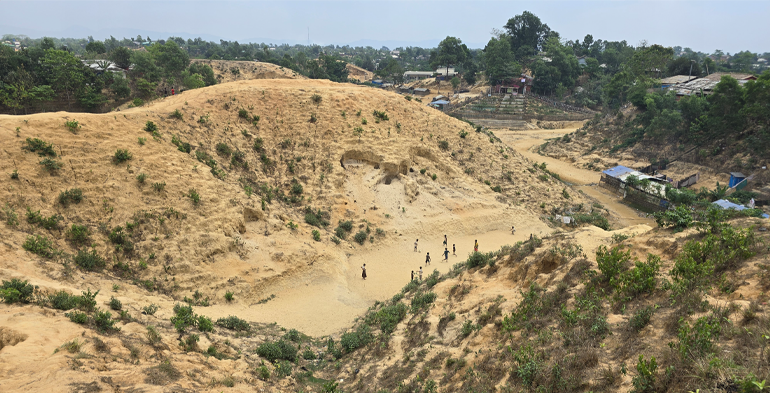
FAO, with funding from Bangladesh Humanitarian Fund, to deliver innovative bioengineering interventions in Cox’s Bazar
Agrilife24.com The Food and Agriculture Organization of the United Nations (FAO) in Bangladesh received USD 584369 from Bangladesh Humanitarian Fund to deliver urgent, life-saving slope stabilization and community preparedness interventions, to help vulnerable Rohingya households mitigate the life-threatening risks of landslides and safeguard shelters ahead of the imminent monsoon season.
The funding will enable FAO to stabilize approximately 170 hectares of high-risk slopes across 85 sites in 15 Rohingya refugee camps within Ukhia and Teknaf. Key activities include planting deep-rooted native vegetation, applying bioengineering techniques such as bamboo crib walls and contour trenching, and providing emergency Cash-for-Work (CfW) opportunities to 800 direct beneficiaries. These interventions will directly reduce the immediate risk of deadly landslides, protecting more than 45000 Rohingya refugees living in high-risk areas by safeguarding shelters, evacuation routes, and access to essential services during the monsoon season.
Jiaoqun Shi, FAO Representative in Bangladesh, stated, “In Cox’s Bazar, fragile and deforested slopes combined with extreme monsoon rainfall are increasing the risk of life-threatening landslides putting thousands of vulnerable people and shelters at immediate risk. Sustainable, cost-effective prevention measures are urgently needed to avert avoidable loss of life and secondary displacement.
I am grateful to the Bangladesh Humanitarian Fund as this support will fill a critical gap of the 2025–2026 Hyper-prioritized Rohingya Joint Response Plan (JRP), where slope stabilization is prioritized as a high-impact, life-saving intervention in the most vulnerable camps.”
He added, “Nature-based solutions are highly cost-efficient, delivering between USD 7 and USD 30 in returns for every USD 1 invested, while simultaneously reducing disaster risks and generating life-saving income.”
FAO is uniquely positioned to deliver this critical support building on its strong technical expertise in nature-based bioengineering, with a strong operational presence in Cox's Bazar. Through the Safe Access to Fuel and Energy Plus (SAFE+) programme, FAO has already stabilized more than 3,500 hectares of degraded slopes since 2018. In humanitarian emergencies, Disaster Risk Reduction (DRR) support is life-saving. By utilizing nature-based soil binding and erosion control techniques, FAO ensures that assistance translates rapidly into physical safety for families living on the front lines of climate vulnerability.
FAO maintains a strong field presence in Cox's Bazar since the Rohingya influx in 2017, working within the Rohingya Coordination Platform (RCP) to ensure interventions are aligned with site management, shelter, and protection responses and reach communities most exposed to hazards. The project activities will be delivered through local community structures including majhis (community leader), imams (Muslim spiritual leader), and youth networks to build long-term ownership and self-reliance.
The Bangladesh Humanitarian Fund enables rapid and flexible financing for the most urgent life-saving priorities. In Bangladesh, this timely support allows partners like FAO to act before predictable hazards such as landslides claim lives or caused secondary displacement.
As climate-induced hazards and acute food insecurity rise globally, FAO is scaling up nature-based slope stabilization and bioengineering to protect vulnerable communities and safeguard their livelihoods. FAO’s 2026 Global Emergency and Resilience Appeal seeks USD 2.5 billion to support over 100 million people in 54 countries. By investing in ecosystem-based early action, FAO helps reduce future humanitarian needs and costs.
This new contribution from Bangladesh Humanitarian Fund underscores the importance of timely, flexible humanitarian funding in saving lives and livelihoods, and highlights the critical role of nature-based solutions as an effective frontline response to climate-driven emergencies.