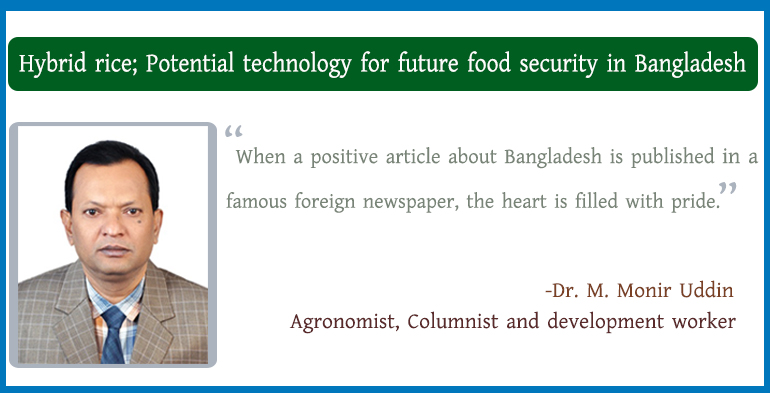
Dr. M. Monir Uddin:On March 10, 2021, an article was published in the New York Times entitled "What can Biden’s plan do for Poverty"? Look to Bangladesh. Nicholas Christoph, a two-time Pulitzer Prize-winning journalist and columnist for the New York Times, looks to Bangladesh as an example of how useful it would be in the wake of American President Joe Biden's announcement of a package to end the country's child poverty. Nicholas Christoph wrote in the opinion column that Bangladesh was born only 50 years ago amid genocide and starvation. Henry Kissinger once compared that country to a bottomless basket.
The catastrophic cyclone of 1991 killed one lakh people. Nicholas Christoph then came to collect news from the coastal region of Bangladesh and wrote a depressing report in the New York Times after seeing pictures of Bangladesh at that time. According to him, his frustration that day has been proven wrong. He wrote that in the 1980s, one third of the people in Bangladesh had completed primary education. The girls did not get a touch of education then. But at present, 98 percent children in Bangladesh are getting primary education. There are more girls than boys in higher secondary education. His writings further highlight the fact that, one in seven children in America who do not pass the level of secondary education. If we help them, the United States will get huge benefits which Bangladesh has shown. Bangladesh teaches us that, investing in marginalized children is not a blessing but a contribution to the development of the nation.
When a positive article about Bangladesh is published in a famous foreign newspaper, the heart is filled with pride. Not only the New York Times, but the whole world is watching the progress of Bangladesh's irresistible development with astonishment. Today, Bangladesh is recognized all over the world as a role model for development. This achievement is due to the strong leadership of the 170 million people of this country as well as the architect of Bengal Bangabandhu Sheikh Mujibur Rahman and his worthy successor the present Prime Minister Sheikh Hasina. Because, if Bangabandhu was not born, there would be no Bangladesh and if not Bangladesh, we would not be able to come to this stage today. It is now internationally recognized that, there has been no development activities up to 1990 in the country after the brutal assassination of Bangabandhu. Because, at this time, the country was in the hands of the anti-independence clique. Ever since Bangabandhu's daughter Sheikh Hasina came to power, she has been working to build the Bangladesh of Bangabandhu's dream and due to her political foresight and prudence, Bangladesh has been included in the list of developing countries from the list of underdeveloped countries. People of Bangladesh believe that, under her strong leadership, Bangladesh will be transformed into a developed country in the near future. However, the first challenge to take Bangladesh forward in the future is to ensure the supply of staple food according to the needs of the people of the country. Because, the people of the country are not a burden but resources and these people will take the country forward.
In the sixties of the nineteenth century, when China could not provide food security to the people of that country, Professor Dr. Long Ping Yuan, known as the father of hybrid rice, began research in 1964 on the application of heterosis in rice production. The first Mail Sterile line was discovered in 1970 on the Chinese island of Hainan. In 1972, IRRI researched under the Hybrid Rice program and discovered the restaurant line, but IRRI's program was later canceled. Already in 1976 Dr. Yuan's efforts led to the commercialization of hybrid rice in China.
IRRI later re-launched the Hybrid Rice program in 1979. Between 1980 and 1990, hybrid rice cultivation spread rapidly in China, thanks to the direct efforts of the Chinese government. In 1994, IRRI introduced hybrid rice and approved its commercial cultivation. In 1995, two lines were commercialized in China. Then in 2004, Professor. Long Ping Yuan won the World Food Prize. In 2008, IRRI formed a consortium to bring 20 million hectares of land around the world under hybrid rice cultivation.
According to FAO, China is the largest rice producer in the world. China's total rice production is 193 million tons, which is 35 percent of the world's total rice production. Because of hybrid rice cultivation, China has been able to feed its 1.35 billion people without any imports. Due to the Hybrid Rice Program, China is a rising star in the world economy today. Seeing the success of China in introducing hybrid rice in food production, many countries have taken initiative to expand the cultivation of hybrid rice. Hybrid rice has been gaining popularity in India since 2004 due to 15 to 25 percent higher yield than conventional varieties.
Reviewing the history of paddy cultivation in Bangladesh, it is seen that in the sixties of the nineteenth century, the average yield of traditional boro, aman and aus were 1.5-2.0 tons, 1-1.5 tons and 1-1.25 tons respectively before introduction of high yielding variety; IRRI-8 in the country. These conventional varieties were light sensitive, meaning that certain varieties could be grown in a particular season. Thus, when the conventional varieties could not meet the food needs of the growing population, the high yielding variety IRRI-8 invented by IRRI, gradually became popular and its cultivation began to expand.
Later, Bangladesh Rice Research Institute started inventing new high yielding rice varieties for different seasons and it spread rapidly in the field. As a result, a silent revolution took place in the field of paddy cultivation in the country. Compared to 1961, it was possible to increase the production of paddy 3 times. Most of the rice varieties developed by Bangladesh Rice Research Institute are light insensitive so it is possible to cultivate the same variety at different times of the year. Thus, it is now possible to get 2 to 3 paddy crops a year from the same land. At present, two popular varieties BRRIdhan- 28 and BRRIdhan- 29 invented by Bangladesh Rice Research Institute are being cultivated in the country during Boro season. Although the yield of BRRIdhan- 28 is slightly lower, the variety is quite popular for low lying areas due to its relatively short lifespan. On the other hand, the yield of BRRIdhan- 29 is high but its life span is 160 to 170 days, so there is a possibility of early flood damage before harvesting paddy. Other rice producing countries have multiple high yielding varieties for cultivation in the same season. One of the advantages of this is that, if for any reason the yield of one crop is adversely affected, it can be compensated by another. In this way we have a little problem because the farmers of the country have become dependent on these two varieties.
Paddy is very important to ensure food security for the people of Bangladesh. Bangladesh has the highest per capita rice intake in the world and the annual per capita rice intake is about 268.5 kg. Rice provides about 69 percent of a person's daily energy supply and 55 percent of a protein supply. Therefore, the security of food and food energy of the country is very much dependent on paddy. Paddy is the most cultivated crop in the country and a source of livelihood for millions of poor farmers. Out of the total 8.6 million hectares of arable land in the country, 6.5 million hectares is fully under paddy cultivation. There are 60.8 million economically active workers in the country's labor market, of which 41 per cent or 24.7 million are directly involved in agriculture. Since 75% of the agricultural land is under paddy cultivation, the agricultural workers are mainly involved in paddy cultivation.
Bangladesh is now almost self-sufficient in paddy production which is one of the major achievements for the country. In 2018, the country spent a total of 42 million tons of rice, of which only 1.5 million tons were imported. In 2019, the average yield per hectare was 4.7 tons and the total production of rice from 11.5 million hectares of land was 54.6 million tons. Bangladesh is currently the third largest rice producer in the world by passing Indonesia after China and India. The release of high yielding varieties by the Bangladesh Rice Research Institute (BRRI), the world's leading research institute, the expansion of micro-irrigation facilities at the individual level and the liberal agricultural machinery import policy of the government have contributed significantly to the achievement of self-sufficiency in paddy production.
The demand for rice in the country is largely driven by population, which means that the demand for rice will increase in the future as the population grows. With a population of 163 million in 2019, it can be estimated that, if the current population growth rate continues at the same rate, the population will stand at 173-213 million by 2050. Due to climate change, the country's rainfall will increase by 10-15 percent at this time, new crop diseases and insect will appear, the availability of groundwater will decrease, as well as the yield will decrease by 10-30 percent. In such a situation, Bangladesh will have to produce 10-35 percent more rice in 2050 than in the current year, without any change in the annual per capita rice consumption of 268.5 kg in 2017. This will require 47-57 million tons as against the current 42.2 million tons of rice production. How can more rice be produced to meet future demand?
Due to the pressure of huge population, the per capita cultivable land decreased from 0.17 hectare in 1961 to 0.05 hectare per capita in 2016. The average size of the farm has come down to 0.68 hectare. The amount of internal freshwater decreased from 2069 cubic meters in 1962 to 679 cubic meters in 2014. So it is almost impossible to increase the paddy land to produce more paddy. In addition, excessive use and misuse of fertilizers and pesticides, as well as excessive extraction of groundwater for irrigation, are already reducing environmental balance and soil fertility. In addition, the yield during the Green Revolution in the 1960s began to decline. During 1962-2000, the average annual growth rate of paddy was 2.03 percent which decreased to 1.74 percent during 2001-2018. In such a situation, one of the essential options to increase rice production in the country is the expansion of hybrid rice technology.
To ensure sustainable rice production and supply in the country, the Government of Bangladesh introduced hybrid rice cultivation through four non-governmental organizations and an NGO during the 1998-99 boro season. Hybrid (F1) seeds are produced by crossing between the lines of two different varieties. The important aspect of hybrid rice is that, it does not yield if it is replanted after seed in the first generation. Therefore, in order to cultivate hybrid paddy, the farmer has to buy new seeds every season. The process of seed production of hybrid rice is very complicated due to which every time the farmer has to buy seeds at a higher price. Hybrid rice gives 15-25 percent higher yield than modern varieties of the country.
In 1998-99, hybrid rice was first cultivated in 23700 hectares of land in the country. The agri-friendly government adopted a liberal seed import policy to expand hybrid rice cultivation in the country. Accordingly, in 2020, a total of 190 hybrid rice seeds were approved in the country, of which 36 were imported from India and 141 from China. 12 of Bangladesh and 1 from the Philippines. Of the 190 varieties released, 13 were for Aman season only, 5 for Aus season only, 169 for Boro season, 3 for Boro and Aman season and 1 for Boro and Aus season. In 2020-21, the government allowed 36 private and 1 government entities to import a total of 5,815 tons of hybrid rice seeds, 180,106 kg of male sterile line seeds (A line) and 525,92 kg of pollen parent line seeds (R line).
Hybrid rice yields 15-25 percent more than the modern varieties invented by the natives. Compared to China and India, hybrid rice cultivation in Bangladesh is very low. In 2009, hybrid rice was grown on 58 percent of China's total rice-growing land. India's total paddy land area is 43.8 million hectares, of which 10 per cent is under hybrid rice cultivation. In Bangladesh, hybrid paddy was cultivated in 686 thousand hectares of land during the 2009-10 boro season, which is only 6% of the total 11.4 million hectares of paddy land in that year (BBS 2014). In 2016-17, the cultivation of hybrid paddy increased to 691 thousand hectares which is only 5.2 percent of the total paddy land of 13.2 million hectares in that year. To date, the cultivation of hybrid rice in the country is limited to the boro season only. Because, there are some limitations in the expansion of hybrid rice cultivation in Bangladesh, among which are most important:
1) The way the farmers of our country cultivate modern varieties of paddy, especially in boro season, BRRIdhan-28 and BRRIdhan-29 cultivate the highest amount of land in the country. Similarly, by cultivating hybrid rice, they do not get higher yield than the native variety. This is because they store the seeds required for the cultivation of indigenous varieties of paddy themselves or use them to buy seeds, but due to the low price, they make seedbeds with more seeds than required. In case of indigenous varieties, 30-40 days old seedlings should be used and 2/3 seedlings per hill should be used, but in many cases farmers plant 4/5 old seedlings per hill and the native varieties give good yield. On the other hand, the price of hybrid rice seeds is 4/5 times higher than that of native varieties. In addition, when the hybrid rice seedlings are more than 30 days old, the yield is greatly reduced. As a result, farmers are more interested in cultivating indigenous varieties.
2) The price of hybrid rice is lower in the market as the hybrid rice is thicker or inferior to the modern variety of rice. As a result, farmers are more interested in using indigenous varieties.
3) The management of urea or nitrogen fertilizers is very complicated due to the short lifespan of hybrid rice which affects the yield and does not yield very much.
4) Hybrid rice seed production is not only technically complex but also quite labor intensive. Therefore, the price of hybrid rice seeds is naturally higher in the market.
5) Since the yield of hybrid rice is 15-25 percent higher than the native variety and its lifespan is also shorter. Therefore, intensive care and management is required at every stage of hybrid rice cultivation. But in the case of native breeds, there is no need to be so careful. As a result, farmers do not feel comfortable in cultivating hybrid rice.
People actually find ways to solve problems. When I was school level student in the seventies and eighties, the field level staff of the Department of Agricultural Extension tried to expand the Japanese hand weeder to cultivate IRRI-8 variety of paddy but the farmers did not accept it at all. That hand weeder farmer came in the 90's to take care of his own needs and didn't have to bring it from Japan anymore. A simple mechanic from a remote village is now making this hand weeder and the farmer is using it in the field. In 2000, I worked with the Department of Farm Power and Machinery of Bangladesh Agricultural University for the expansion of Rice-Wheat Reaper and Manual Thresher with the financial support of DFID. In the surrounding districts including Tangail, we tried to expand it by cutting paddy and wheat with the reaper of Japanese Kubota company but we were not successful at that time. But today, not only reapers but also sophisticated harvesters, rice trans-planter and modern thresher machines are being used in the country for paddy cultivation. So today the hybrid rice may not be expanding as expected in the country but this hybrid rice will be expanded by the farmers themselves in the interest of increasing the rice production of the country in the future.
According to FAO, hybrid rice technology is an important way to increase global rice production. In order to maintain self-sufficiency in the country's food production in the future, the production of paddy will have to be increased at least 2.5 per cent more than at present in view of the rate at which the population is increasing and the amount of land under paddy cultivation is declining. Hybrid rice is an economically viable technology to sustain the increase in paddy production in Bangladesh which yields 15-25 percent more than the domestic improved varieties. A country like Bangladesh where there is a severe shortage of land and it is gradually decreasing day by day. As well as the pressure of paddy cultivation is high, there is no opportunity for crop diversification. In this context, hybrid rice technology is an effective way to increase rice production to feed the growing population in future. Therefore, considering all that needs to be done to increase the cultivation of hybrid rice in the country in the future
(A)) In order to get maximum yield of paddy through hybrid paddy cultivation, skills should be enhanced by training the field level officers of the Department of Agricultural Extension and farmers on its proper and systematic method and management.
(B) Since the land in the country is decreasing but the production of paddy has to be increased, the cultivation of paddy has to be done digitally now. In other words, in order to get the desired yield, the farmer has to give advice by calculating how many hills should be in one hectare of land, how many effective tillers should be in each hill, how many effective grains should be in each tiller, etc. Only then can the desired paddy yield be ensured.
(C) The lifespan of hybrid rice is less i.e. 110-130 days. Since these varieties yield more in less time, more food is required in less time. In particular, proper management of urea fertilizer in a short period of time is quite complicated. Therefore, urea fertilizer should be given in quantity at the right time as per the requirement of the plant. In order to get proper yield, the age of seedlings in hybrid paddy cultivation should not be more than 30 days.
(D) In my PhD research, I did research to find out the dose of nitrogen briquette (Guti urea) to get the highest yield of native modern varieties and hybrid varieties of rice. I use BRRIdhan-29 and Supreme Seed Company's hybrid line Hira 99-5 as indigenous varieties in boro season. As well as three plant spacing such as 20 cm.× 20 cm., 20 cm.× 15 cm. and 25 cm.×15 cm. were used in research plots. The 20 cm.×20 cm at a distance of 250,000 hills per hectare, 20 cm×15 cm at a distance of 3,33,333 hills per hectare and 25 cm×15 cm at a distance, the number of hills per hectare was 2,66,666. The results showed that 25 cm.×15 cm the use of 3.6 gm nitrogen briquette for each of the four hills at a distance yields a maximum of 10.74 tons of paddy by Hira 99-5 hybrid using 240 kg of nitrogen briquette per hectare. Therefore, in the context of our country, the use of nitrogen briquette can be a profitable and environmentally friendly technology to get the maximum yield for the short life of hybrid rice so that there is no latent hunger for nitrogen deficiency.
Due to the changing needs, people are inventing new technologies and by adopting them, human civilization is also surviving. In continuation of this, people are carrying out new research to get more food for the people. Thus, Professor Dr. Long Ping Yuan invented hybrid rice. This hybrid rice is being cultivated in 60 percent of China's paddy lands, meeting the food needs of China's 1.35 billion people. According to Chinese experts, this hybrid rice has contributed to China's economic prosperity in the world. Hybrid rice can also be a potential technology for this populous Bangladesh. In the meantime, several varieties of hybrid rice have arrived in the country from China through private sector initiatives with a lifespan of 110 to 130 days and yielding capacity of 10 to 12 tons per hectare. Therefore, if we want to see the country self-sufficient in food in the future as well, if we want to produce crops according to the needs of the growing population, then the expansion of hybrid rice is very important. According to Chinese expert Dr. Jee, the Chinese government acted as a force behind the way hybrid rice became popular and expanded in China between the 1980s and 1990s. According to the Department of Agricultural Extension, in the 2021 boro season, a total of 48 lakh 83 thousand 760 hectares of land has been cultivated in the country. Of this, hybrid paddy has been cultivated in a total of 12 lakh 13 thousand 450 hectares of land with the help of government seeds support, which is a very commendable initiative. In this way, if the government provides technical and seed assistance in hybrid rice cultivation, we will be safe in terms of food security in the future as well. In this way, our agri-friendly government like China will take the initiative to expand hybrid rice cultivation so that we can continue to be self-sufficient in the staple food in the future.
Source of Information: CIMMYT, FAO and Other Online Report
Writer:Agronomist, Columnist and development worker.