




















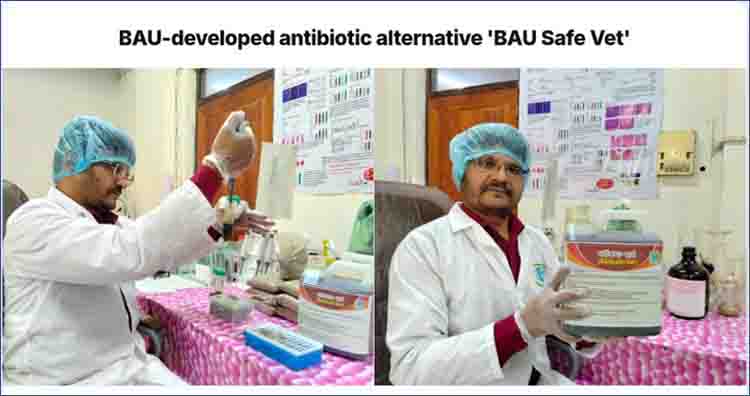



Mohammad Riaz, BAU :Researchers at Bangladesh Agricultural University (BAU) have developed an antibiotic-free solution from neem leaf extract to help combat the risk of antimicrobial resistance (AMR) associated with antibiotic use in broiler farming. Named ‘BAU Safe Vet’, the solution is the outcome of eight years of research led by Prof Dr Md Shafiqul Islam of the Department of Pharmacology.
The research was funded by the University Grants Commission (UGC), the Ministry of Science and Technology, and the Bangladesh Agricultural University Research System (BAURES).
According to the researchers, the neem-based solution has five beneficial properties, including antibacterial, growth-promoting and immunostimulant effects. It can help control diseases in chickens, improve weight gain and enhance meat quality.
Its use can also reduce the need for other antibiotics, vitamins and minerals, potentially lowering poultry production costs and increasing farmers’ profits. The solution is currently sold by BAU’s Department of Pharmacology at a nominal price per litre. The researchers have also recently secured patent-related benefits for the product.
The solution has significant commercial potential if it can be produced and marketed on a large scale as an alternative to antibiotics in broiler farming. However, financial constraints, a shortage of necessary equipment and a lack of manpower have limited production.
The researchers believe that adequate funding and increased production capacity could help expand the solution commercially and contribute positively to the country’s poultry sector.
Prof Dr Md Shafiqul Islam said the phytobiotic solution was developed to ensure a safe supply of meat for consumers.
Our research indicates that the solution contains no ingredients harmful to human health or chickens.
He further said the use of the solution had reduced the chicken mortality rate to around one per cent, while the feed conversion ratio (FCR) stood at 1.2.
He said Its use also reduces the need for other antibiotics, vitamins and minerals, lowering production costs and increasing farmers’ profits. However, despite demand among farmers, large-scale production remains difficult due to a lack of necessary equipment.
After tasting broiler meat produced using BAU Safe Vet, Prof Dr Anisuzzaman of BAU’s Department of Medicine said the meat tasted much like that of native chickens.
He said the unusual smell sometimes found in conventional broiler meat was absent. This is a promising initiative for producing safe meat.
Sharing similar experiences, Prof Dr Harunur Rashid of the Department of Fisheries Management and Prof Dr Masum Ahmad of the Department of Entomology at BAU said the meat of broilers raised using BAU Safe Vet had an appealing colour and a firmer texture, resembling native chicken meat. The solution could be used as a promising option for producing safe poultry meat.