























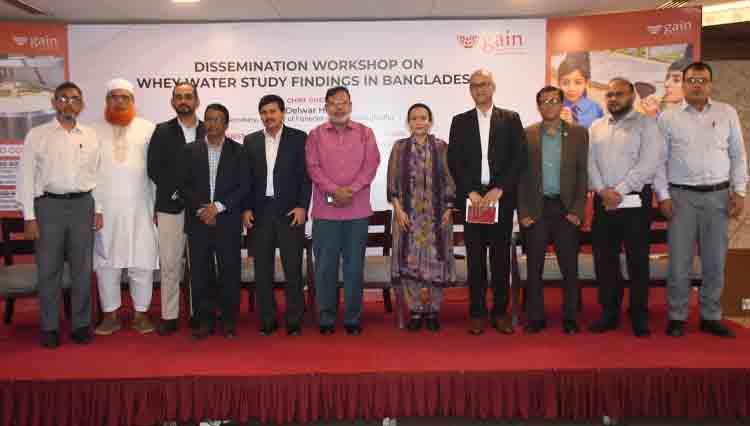
 Agrilife24.com: Government officials, researchers, development partners, and private-sector representatives have emphasized the need to transform nutrient-rich whey water, a by-product of dairy processing, into value-added products instead of disposing of it as waste. They highlighted its potential to create new investment and business opportunities, improve nutrition, support entrepreneurship, and reduce environmental pollution.
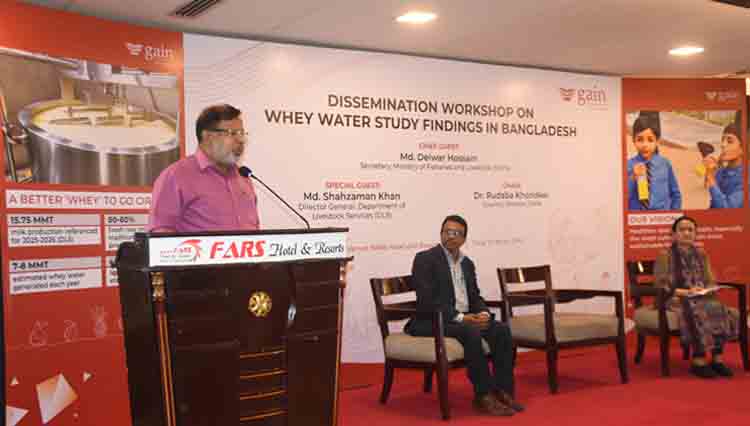
The observations were made at the “Dissemination Workshop on Whey Water Study Findings in Bangladesh,” organized by the Global Alliance for Improved Nutrition (GAIN) Bangladesh at FARS Hotel & Resorts, Paltan, Dhaka today (29 September). The workshop presented the findings of the feasibility study, investment opportunities, and possible pathways for future action.
Md. Delwar Hossain, Secretary, Ministry of Fisheries and Livestock, attended the event as the Chief Guest, while Dr ABM Khaleduzzaman, Director (Budget), Department of Livestock Services (DLS), attended as the Special Guest. Dr. Rudaba Khondker, Country Director, GAIN Bangladesh, delivered the closing remarks.
Dr. Ashek Mahfuz, Portfolio Lead, GAIN Bangladesh, delivered the welcome address, while Ahmed Shihab Zaman, Project Manager, GAIN Bangladesh, presented the investment opportunities for whey water utilization in Bangladesh.
The key findings of the feasibility study were presented by Mohd. Abul Kalam Azad, Team Leader of the Study, National Dairy Expert and Advisor to MIMBA (Modern Integrated Management of Bovine Agriculture). The study team also included Dr. Md. Tajammul Haque, Associate Consultant of the Study and Founder & CEO of MIMBA; Tanvirul Islam, ICT Expert of the Study; and Alvi Al Hridoy, Data Analyst.
The study found that a significant volume of whey water is generated during the production of chhana, paneer, cheese, and traditional sweetmeats in Bangladesh, but much of it remains underutilized and is discarded. Whey water, however, contains valuable nutrients, including lactose, serum proteins, minerals, and water-soluble vitamins.
The study identified opportunities to utilize whey water for producing nutrient-enriched beverages, probiotic and fermented products, whey powder, whey protein, bakery ingredients, and animal feed supplements. It also highlighted several areas requiring attention for commercialization, including whey collection and storage systems, cold-chain facilities, appropriate processing technologies, financing, food safety and quality standards, and market linkages.
Representatives from a wide range of institutions were included in the workshop, including the Department of Livestock Services, Bangladesh Livestock Research Institute, Bangladesh Agricultural Research Council, Bangladesh Dairy Development Board, Bangladesh Food Safety Authority, BSTI, universities, Milk Vita, PRAN Dairy, Aarong Dairy, Akij Dairy, the World Bank, Asian Development Bank, FAO, IFAD, World Health Organization, development partners, and diplomatic missions.
The discussions emphasized the importance of initiating pilot interventions in potential dairy-processing clusters, establishing organized whey collection and aggregation systems, introducing affordable processing technologies, ensuring food safety, supporting entrepreneurs, and strengthening public-private partnerships.
A key message emerging from the workshop was that whey water should be viewed not as waste, but as a valuable dairy resource. With appropriate technology, research, policy support, and investment, better utilization of whey water could create new nutritional products and business opportunities while contributing to reduced food loss and environmental pollution in Bangladesh.