




















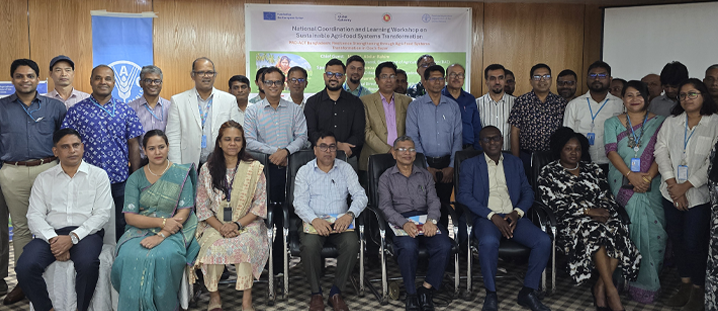




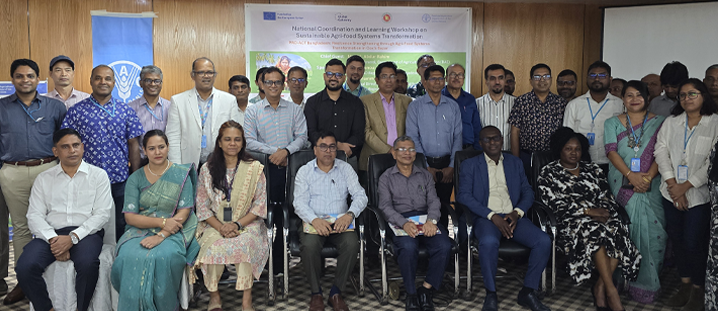
 Government, EU and UN partners gather to review the Aggregation Centre model and chart the path for wider scale-up under the PROACT project
Agrilife24.com:The Department of Agricultural Extension (DAE), in collaboration with the Food and Agriculture Organization of the United Nations (FAO), convened a Coordination and Learning Workshop on Sustainable Agri-food Systems Transformation toady (16 August). The high-level event brought together senior government officials, UN agencies, and NGO/INGOs. Attendees reviewed progress under the EU-funded Pro-Resilience Action (PROACT) project, "Resilience Strengthening through Agri-Food Systems Transformation in Cox's Bazar", focusing on ways to institutionalize its innovations into national systems.
The workshop showcased field experiences and highlighted the success of the Aggregation Centre (AC) model. It also discussed findings of two technical assessments: climate-smart fish-drying Technologies and the Effectiveness of agent banking services delivered through ACs.
“The PRO-ACT project has demonstrated that Aggregation Centres can effectively bring climate-smart technologies, digital advisory services, quality inputs and market linkages closer to smallholder farmers,” said Dr. Md. Zakir Hossain, Director, Admin and Finance, Department of Agricultural Extension.
He added, “DAE is committed to building on these experiences and exploring opportunities to institutionalize and scale the Aggregation Centre model within the national agricultural extension system. With appropriate policy support, resources and partnerships, we can sustain these services beyond the project and extend their benefits to farming communities across Bangladesh.”
Implemented by FAO in close collaboration with DAE, under the Ministry of Agriculture, PROACT operates across Cox's Bazar Sadar, Ramu, Ukhiya and Teknaf sub-districts. The project aims to improve food and nutrition security, expand livelihood opportunities, and strengthen resilience among farming households through climate-smart crop production, fish farming, sustainable dried-fish production, stronger agricultural value chains, market access, and financial literacy.
A central pillar of PROACT is the FAO-supported Aggregation Centres (ACs). These platforms integrate climate-smart agriculture, digital extension advisories, post-harvest handling, and market linkages for smallholder and marginalized farming households. DAE Cox's Bazar provides the institutional and technical leadership for the ACs. As of today, the project has already trained 10,000 households in nutrient-dense vegetable production.
“FAO is proud to stand alongside the Department of Agricultural Extension and the European Union in advancing this important work in Cox's Bazar”, said Dia Sanou, Deputy FAO Representative in Bangladesh. “The Aggregation Centre model shows that we can transform the lives of many people when climate-smart agriculture, digital advisory services and market linkages are brought together around the needs of smallholder and marginalized farming households.”
Sanou added “As PROACT moves into its next phase, FAO remains committed to working with DAE to ensure that the lessons learned here translate into lasting benefits well beyond Cox's Bazar.”
The event concluded with technical presentations and an open discussion where, government and field-level stakeholders discussed out replication strategies to sustain these agricultural practices beyond the project lifecycle.