




















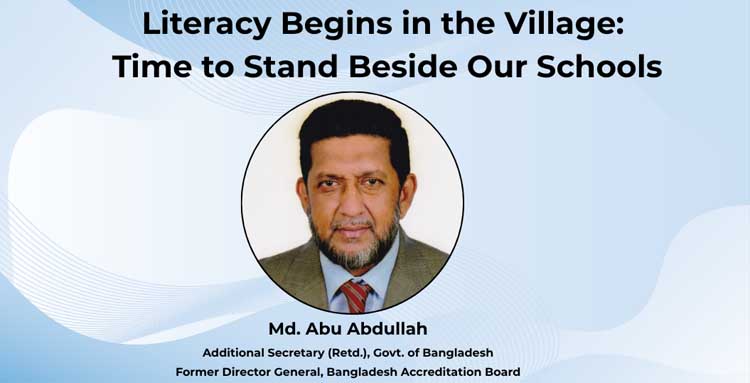




Md. Abu Abdullah: On International Literacy Day 2026, Bangladesh must move beyond enrolment and ensure that every child truly learns.As Bangladesh observes International Literacy Day on 8 September 2026 under the theme “Literacy for People, the Planet and Prosperity,” it is worth looking beyond statistics, policies and national programmes and asking a simple question: Are our children actually learning?
The answer may be found in the classrooms of thousands of rural schools across Bangladesh.
Bohalbaria Government Primary School in Mohammadpur, Magura, is one such institution. Located among fields and canals, the school has served children from Bohalbaria, Khalia, Baliadanga and Char Pukuria for more than three decades. Established in 1991 through the initiative of local education enthusiasts, it began with a simple but powerful objective to bring education closer to children in a remote rural community.
The school has survived and continued its mission despite many challenges. In 2006, it had 176 students, including 87 girls. Today, enrolment stands at 74, roughly half of them girls. Under Headmaster Sokina Akter and three assistant teachers, classes continue in three ageing classrooms. Space limitations have affected pre-primary education, while children from Char Pukuria and nearby areas face difficult rural routes and canals on their way to school. Basic facilities, including a fully functional tube well, also require attention.
Yet every morning, children continue to arrive. Their presence tells an important story: rural parents still believe that education is one of the most reliable pathways to a better future.
For poor families, however, schooling comes with sacrifices. Parents often spend between Tk 45 and Tk 200 a month on stationery, uniforms and other educational necessities. These amounts may appear modest, but for a financially vulnerable household they can be significant. Still, parents continue to make the sacrifice because they believe education can change their children's lives. That faith deserves stronger support from society.
From access to learning. Bangladesh has made remarkable progress in expanding access to education. Since independence, the country has established more schools, increased enrolment and made significant progress in girls' participation. These achievements reflect public investment, the dedication of teachers, community contributions and support from development partners.
But the next stage of our educational journey must be about quality and meaningful learning.
A child may attend school regularly and still fail to acquire the basic ability to read with understanding, write clearly and perform elementary mathematics. If foundational literacy and numeracy are not developed during the early years, learning gaps can widen as children move through higher grades.
Therefore, the question before Bangladesh should no longer be simply, “How many children are enrolled?” It should also be, “How much are they learning?”
Assessment, accordingly, should not merely rank students or schools. It should help teachers identify children who are struggling and provide timely support. Every child who falls behind in the early grades deserves the opportunity to catch up.
Teachers need the community behind them. Teachers are at the heart of educational improvement. No education system can become stronger than the support it provides to those who teach children every day.
Rural teachers, in particular, often work under difficult circumstances. They need quality teaching materials, continuous professional development, practical mentoring and support in dealing with children with different learning abilities.
A school is not merely a government institution. It is a community institution. Parents, former students, local leaders, educated residents, professionals living in towns and cities and other well-wishers all have a role to play.
Community participation should go beyond attending occasional meetings. People should visit their local schools, talk to teachers and ask practical questions: Can children in the early grades read with understanding? Are weaker students receiving additional support? Do teachers have sufficient books and learning materials? Are water and sanitation facilities adequate? Are children attending regularly? Are parents communicating with teachers? These are not questions of criticism. They are questions of collective responsibility.
Former students can reconnect with their schools. Professionals can share knowledge and ideas. Well-wishers can contribute books and learning materials. Community leaders can help identify children at risk of dropping out and encourage their families to keep them in school.
Literacy for people, planet and prosperity. The 2026 International Literacy Day theme is particularly meaningful for rural Bangladesh.
Literacy for People is ultimately about human dignity and opportunity. A child who can read, understand, communicate and think confidently has a better chance of continuing education, finding productive employment and participating actively in society.
Literacy for the Planet is equally important. Rural communities are directly connected with agriculture, water, land and the natural environment. Future generations will need the knowledge to understand climate change, environmental risks, sustainable agriculture, sanitation and responsible use of natural resources.
A literate child today may become tomorrow's environmentally conscious farmer, entrepreneur, teacher, engineer or community leader.
And Literacy for Prosperity connects education with Bangladesh's economic future. Foundational skills acquired in primary school create the basis for higher education, productive employment, entrepreneurship, innovation and participation in an increasingly knowledge-based economy.
Thus, investment in literacy is not simply an investment in education. It is an investment in people, communities, the environment and the future economy of Bangladesh.
Bohalbaria Government Primary School may be small, but its importance cannot be measured by the size of its buildings. Every child sitting in its classrooms represents a possible future teacher, doctor, farmer, entrepreneur, engineer, public servant or community leader.
The country has largely won the battle for access. The more difficult battle now is to ensure quality, foundational learning and equal opportunity. This requires sustained attention to early-grade literacy and numeracy, regular learning assessment, teacher development, books and libraries, support for disadvantaged communities and stronger school-level accountability.
On this International Literacy Day, therefore, let us redefine what it means to support a school.
It does not always require a large donation or a major construction project. Sometimes it begins with a visit. A conversation with a teacher. Encouraging a child. Giving a book. Helping a struggling learner. Supporting regular attendance. Reconnecting former students with their old school.
Most importantly, it begins when local people start thinking of the school as their own investment in the next generation.
The future of Bangladesh will not be secured by enrolment alone. It will be secured when every child who enters a classroom has the opportunity to learn, understand, dream and progress.
For the people of Bohalbaria, Khalia, Baliadanga, Char Pukuria—and for communities across Bangladesh—the message on International Literacy Day 2026 is therefore simple:
Come forward. Visit your school. Stand beside the teachers. Encourage the children. Support those who are struggling. Help improve the learning environment.
Md. Abu Abdullah is a former Additional Secretary and a contributor to the “Light of the Village” initiative, which highlights rural institutions and community-led development in Bangladesh. mdabuabdullah@gmail.com