




















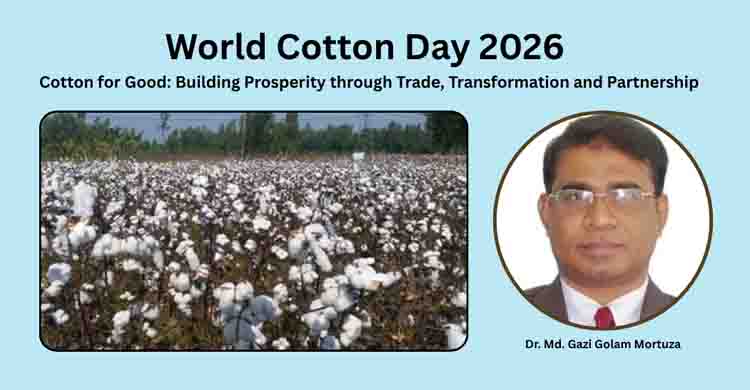




 Dr. Md. Gazi Golam Mortuza:Bangladesh is the world’s second-largest garment exporter, relying heavily on cotton to fuel its economic engine. As global supply chains shift toward sustainability, the country faces a pivotal moment. The future of Bangladesh’s textile industry depends on turning the raw material supply chain into a force for social, economic, and environmental good. Cotton is a source of livelihoods for millions of smallholders and labourers, including women and their families, and contributes significantly to the economies of many developing countries like Bangladesh. World Cotton Day is a celebration of cotton and an opportunity to show its enduring positive impact. From supporting millions of livelihoods to providing a renewable, biodegradable, natural fiber, cotton delivers economic, social, and environmental benefits around the world. The global community is invited to join us in celebrating the world’s most important natural fiber. It’s a poverty-alleviating crop in some of the least developed countries in the world, providing sustainable and decent employment to people across the globe. Basic needs of human beings are food, clothing, shelter, medical care and education. From the point of view of civilization, clothing is our first basic need. The basic and main ingredient of this textile industry is cotton. Cotton cloth is one of the most common fabrics in our daily life.
The theme of World Cotton Day 2026 is ‘Cotton for Good: Building Prosperity through Trade, Transformation and Partnership”. The objectives of global celebration of the day are to raise awareness of the importance of cotton and cotton-related products, to highlight the vital role that cotton plays in economic development and poverty alleviation in least-developed countries and to promote the international trade of cotton and enable developing and least-developed countries to benefit from the cotton supply chain industries. From supporting millions of livelihoods to providing a renewable, biodegradable natural fiber, cotton delivers economic, social, and environmental benefits around the world.
This year World Cotton Day 2026 is jointly organized by the Government of the Republic of Uzbekistan and the International Cotton Advisory Committee (ICAC), with the participation of the Food and Agriculture Organization of the United Nations (FAO), the World Trade Organization (WTO), the United Nations Industrial Development Organization (UNIDO), the International Trade Centre (ITC) and the United Nations Conference on Trade and Development (UNCTAD) on 7 October 2026 in Tashkent, Uzbekistan, under the theme "Cotton for Good: Building Prosperity Through Trade, Transformation and Partnership". This event will address the sector's challenges and opportunities, with discussions on how to improve productivity, explore strategies to add value throughout the chain, and highlight the role of trade in the sector's sustainability.
Therefore, World Cotton Day 2026 is very important in terms of economic, social, and environmental benefits for the world as well as Bangladesh. It is grown primarily as a fibre crop, but after the lint, the long twisted unicellular hairs are removed by ginning, the seed can be crushed to extract vegetable oil and protein rich animal food. More than 100 countries are involved in export and import of raw cotton. It provides food, animal feed, fibre and fuel. It sustained millions of people for their livelihood at farms, ginning factories, textile mills, edible oil and soap industry etc.
At first the WTO hosted the launch of World Cotton Day on 7 October 2019 following an initiative of the four cotton producers in sub-Saharan Africa– Benin, Burkina Faso, Chad and Mali, known as the Cotton Four Countries. During two consecutive years, the date offered an opportunity to share knowledge and showcase cotton-related activities.
After that The United Nations General Assembly took decision on 30 August 2021, to officially recognize 7 October as World Cotton Day. The UN resolution (A/RES/75/318) proclaiming World Cotton Day acknowledges and recognizes its broader economic and social impact around the world. From that time, every year cotton producing and consuming countries observe World Cotton Day. Now the United Nations (UN) has officially observe this World Cotton Day. This great opportunity creates awareness of the need of market access for cotton and cotton-related products from least developed countries, fosters sustainable trade policies and enables developing countries to benefit more from every step of the cotton value chain.
Cotton is widely grown and an important cash crop in the world as well as Bangladesh. Cotton is a soft and fluffy staple fiber. The fiber is almost pure cellulose. Cotton is cultivated in tropical and subtropical regions of more than seventy five countries of the world, on 33-35 million hectors in each year, which represents 2.5% of the all cultivated land. More than 100 million families are directly involved in cotton production and produced 25-26 million ton of raw cotton, where average lint production is about 800 kg per hectare. It is grown primarily as a fibre crop, but after the lint, the long twisted unicellular hairs are removed by ginning, the seed can be crushed to extract vegetable oil and protein rich animal food. More than 100 countries are involved in export and import of raw cotton. It provides food, animal feed, fibre and fuel. It sustained millions of people for their livelihood at farms, ginning factories, textile mills, edible oil and soap industry etc.
About 80-85 lakh bales of fiber cotton are required annually for the 450 spinning mills of the textile sector in Bangladesh, the bulk of which is met by imports from abroad and this demand is increasing. About 25-30 thousand crore Taka have to be spent every year to import this amount of cotton. At present, only three percent of the total demand can be met in our country, the remaining 97 percent of cotton has to be imported from abroad. 5000 Garments and other sectors of ready-made garments directly involve about 50 lakh people. Considering these, World Cotton Day 2025 is very important for Bangladesh. In the financial year 2024-25, the textile sector earned 39.35 billion US dollars. Moreover, 81.49 % of our foreign exchange earnings come from the RMG sector. One ton of cotton provides employment to five people on an average for almost a year. Among agricultural crops, cotton is the only crop from which both food and clothing are obtained.
The ICAC estimates that each ton of cotton lint provides full-time, year-round income to about five people. A whopping 43% of cotton farmers worldwide are women, providing them with a much-needed source of income to support their families. Cotton sequesters carbon. During production, cotton generates about 1.7 kg of greenhouse gases but it absorbs 2.2 kg, meaning cotton literally removes carbon from the atmosphere as it grows. It biodegrades quickly compared with synthetic alternatives, decreasing the amount of plastics entering our waterways and helping to keep our oceans clean. It provides fiber but also food, for both humans and livestock. As a crop that grows in arid climates, it thrives in places no other crop can.
From the ancient time, the finest cotton fabric- Moslin once produced in medieval Bengal was famous throughout the world. The cotton for producing Moslin was grown on high lands around Dhaka where most muslin handlooms were located. At one time the muslin of Bangladesh was world famous. The royal saree “muslin” made in this country was world famous. This muslin cotton was produced in this country. During the British rule, that cotton and muslin was lost in time. At present, the textile and garment sector is the main export and foreign exchange earning sector of Bangladesh.
The year 2009 was assigned the international year of natural fibres by the UN. Natural fibre industries employ millions of people all over the world, especially in the developing countries. As the major non-food commodity natural fibres and their products are processed in many small and large industries and consumers all over the world profit from the provided products.
Cotton is used by millions every single day across the world and the demand for cotton is expected to rise over the coming years. This hike in demand has increased the need for sustainable cotton. Ways to produce cotton while caring for the environment are at the forefront of conversations in the drive for sustainability. Conventional cotton production currently accounts for 18 percent of worldwide pesticide use and producers of cotton are being poisoned by heavy pesticide use. Sustainable cotton production is the solution to these issues. It reduces the use of hazardous chemicals, uses less water, and reduces poverty for cotton farmers.
Government and other policy makers should develop positive support to boost up the cotton production. World Cotton Day, 2026 is an opportunity to show the positive impact on cotton, which will continue to have in the future and convince the international community to join the celebration. Cotton offers several important advantages: it is renewable, plant-based, biodegradable, recyclable, and capable of being produced within farming systems that build healthier soils and use resources more efficiently. Continued innovation can improve those benefits further. By producing cotton more efficiently, protecting and rebuilding agricultural soils, extending the life of cotton products, and choosing renewable natural fibers where they make sense, the cotton and textile sectors can contribute to a more sustainable future. World Cotton Day serves as a key opportunity to spread knowledge and showcase cotton-related activities and products. So, the World Cotton Day 2026 is an excellent opportunity to renew our commitment to enhancing the sustainability of the cotton sector and bring it to the forefront of the global agenda.
-Wrter:Soil Nutrition and Water Management Specialist
Cotton Development Board (HQ), Tula Bhaban, Farmgate, Dhaka
Email: mortuzacdb@gmail.com