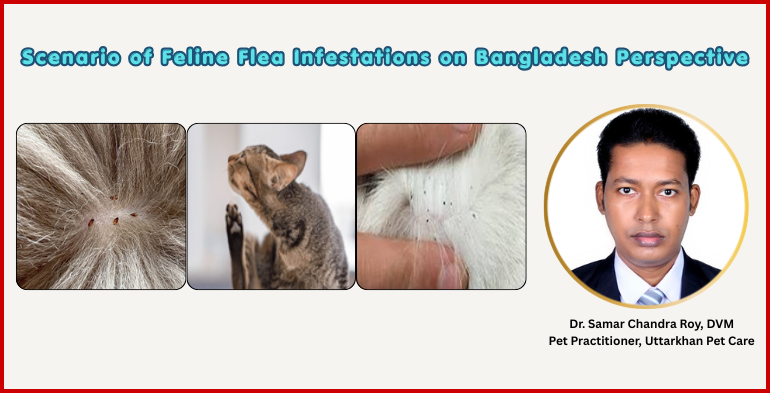
By Dr. Samar Chandra Roy, DVM
Introduction
Flea infestation is one of the most common ectoparasitic problems affecting cats worldwide, including Bangladesh. Fleas are small, wingless, blood-sucking insects belonging to the order Siphonaptera. Among them, the cat flea, Ctenocephalides felis, is the most prevalent species infesting cats and is widely distributed across tropical and subtropical regions.
In Bangladesh, where warm temperature, humidity, and dense human-animal interaction prevail, flea infestation is a significant veterinary and public health concern. Both pet and stray cats serve as reservoirs, facilitating transmission not only among animals but also to humans (zoonotic significance).
- Etiology
The primary etiological agent of flea infestation in cats is:
1.1 Causative Agent
- Ctenocephalides felis (cat flea) – most common
- Occasionally: Ctenocephalides canis (dog flea)
These fleas are obligate hematophagous ectoparasites, meaning they survive by feeding on the host’s blood.
1.2 Morphology
- Small (1–4 mm), reddish-brown
- Laterally compressed body
- Long hind legs adapted for jumping
- Wingless but highly mobile
1.3 Life Cycle
The flea life cycle has four stages:
- Egg
- Larva
- Pupa
- Adult
Important features:
- Eggs fall into the environment (bedding, soil, carpets)
- Larvae develop in organic debris
- Pupae can survive for months under unfavorable conditions
- Adult fleas remain on the host
This lifecycle explains why environmental contamination plays a key role in infestation persistence.
- Epidemiology (Bangladesh Perspective)
2.1 Prevalence
Studies in Bangladesh indicate that flea infestation is common in both stray and domestic cats. One study reported a higher prevalence in stray cats compared to pets, emphasizing poor management and lack of treatment.
- Stray cats: high infestation rates (~79%)
- Pet cats: lower but significant (~11%)
2.2 Risk Factors
Key risk factors include:
- Warm and humid climate (ideal for flea survival)
- Poor hygiene and overcrowding
- Presence of stray animals
- Lack of regular ectoparasite control
- Outdoor access of pet cats
Fleas thrive especially in tropical climates like Bangladesh, where environmental conditions support rapid reproduction.
2.3 Host Range
Cat fleas are not host-specific:
- Cats (primary host)
- Dogs
- Livestock
- Humans (accidental host)
2.4 Zoonotic Importance
Fleas act as vectors of several pathogens:
- Bartonella spp. (cat scratch disease)
- Rickettsia felis
- Dipylidium caninum (tapeworm)
Transmission occurs through bites or ingestion of infected fleas.
- Pathogenesis
The pathogenesis of flea infestation involves both direct and indirect effects.
3.1 Blood Feeding and Irritation
Adult fleas bite the skin and inject saliva:
- Causes irritation and inflammation
- Leads to itching (pruritus)
3.2 Flea Allergy Dermatitis (FAD)
- Hypersensitivity reaction to flea saliva
- Even a few fleas can trigger severe reactions
3.3 Blood Loss
- Heavy infestations may cause anemia
- Particularly dangerous in kittens
3.4 Secondary Infections
- Continuous scratching leads to:
- Skin wounds
- Bacterial infections
- Dermatitis
3.5 Disease Transmission
Fleas act as vectors:
- Transmit pathogens between animals
- Spread zoonotic infections to humans
3.6 Environmental Amplification
- Eggs and larvae in surroundings lead to reinfestation
- Difficult to control without environmental management
- Clinical Signs (Symptoms)
Clinical signs vary depending on infestation severity and host sensitivity.
4.1 Mild Infestation
- Occasional scratching
- Presence of fleas or flea dirt
4.2 Moderate Infestation
- Frequent scratching and grooming
- Hair loss (alopecia)
- Redness of skin
4.3 Severe Infestation
- Intense pruritus
- Crusts and scabs
- Thickened skin
- Secondary bacterial infection
4.4 Flea Allergy Dermatitis (FAD)
Common signs:
- Severe itching
- Hair loss (especially tail base, neck, abdomen)
- Papules and erythema
4.5 Systemic Signs
- Anemia (pale mucous membranes)
- Weakness
- Weight loss
4.6 Zoonotic Manifestations
Humans may develop:
- Itchy papules
- Urticaria
- Dermatitis
- Diagnosis
5.1 Clinical Examination
- Observation of scratching behavior
- Skin lesions
- Distribution pattern (tail base, neck)
5.2 Detection of Fleas
- Visual identification of adult fleas
- Use of flea comb
5.3 Flea Dirt Test
- Black specks (digested blood)
- Turns reddish when moistened
5.4 Laboratory Identification
- Microscopic examination
- Identification of Ctenocephalides felis morphology
5.5 Differential Diagnosis
Must differentiate from:
- Mange (mites)
- Lice infestation
- Allergic dermatitis
- Fungal infections
5.6 Advanced Diagnostics
- Skin scraping
- Allergy testing (for FAD)
- Treatment
Effective treatment requires both animal and environmental control.
6.1 Treatment of the Cat
6.1.1 Topical Insecticides
- Spot-on formulations (e.g., fipronil, imidacloprid)
- Applied on skin
6.1.2 Oral Medications
- Isoxazoline group (e.g., fluralaner, afoxolaner)
- Rapid killing of fleas
6.1.3 Flea Shampoos
- Provide immediate relief
- Not long-lasting
6.1.4 Growth Regulators
- Prevent egg and larval development
6.1.5 Supportive Therapy
- Antihistamines (for itching)
- Antibiotics (secondary infection)
- Iron supplements (for anemia)
6.2 Environmental Control
Essential in Bangladesh due to climatic conditions.
Measures include:
- Regular cleaning of bedding
- Vacuuming carpets and furniture
- Washing with hot water
- Use of insecticides in environment
Flea eggs and larvae survive in surroundings, making environmental control critical.
6.3 Treatment Challenges in Bangladesh
- Large stray cat population
- Limited veterinary access in rural areas
- Low awareness among pet owners
- Poor hygiene conditions
These factors contribute to persistent infestation cycles.
- Prevention
Prevention is the most effective strategy against flea infestation.
7.1 Regular Prophylaxis
- Monthly flea preventive treatments
- Veterinary-recommended products
7.2 Environmental Hygiene
- Clean living spaces
- Avoid accumulation of organic debris
7.3 Control of Stray Animals
- Reduce contact with stray cats
- Community awareness programs
7.4 Grooming
- Regular brushing
- Routine inspection
7.5 Veterinary Care
- Periodic health check-ups
- Early detection and treatment
7.6 Public Awareness
- Education on zoonotic risks
- Proper pet management
- Public Health Importance
Flea infestation is not only a veterinary issue but also a public health concern in Bangladesh.
Key concerns:
- Transmission of zoonotic diseases
- Human infestation cases reported in Bangladesh
- Increased risk in urban areas with high pet density
The concept of One Health (human-animal-environment interaction) is highly relevant.
Conclusion
Flea infestation in cats is a widespread and significant problem in Bangladesh due to favorable environmental conditions, high stray animal populations, and inadequate preventive practices. The primary causative agent, Ctenocephalides felis, not only causes irritation and dermatitis in cats but also plays a role in transmitting zoonotic diseases.
Effective control requires a holistic approach, including:
- Treatment of the affected animal
- Environmental management
- Preventive measures
- Public awareness
Addressing flea infestation is essential for improving animal welfare, reducing economic losses, and protecting public health in Bangladesh.
- Writer: Pet Practitioner, Uttarkhan Pet Care