


















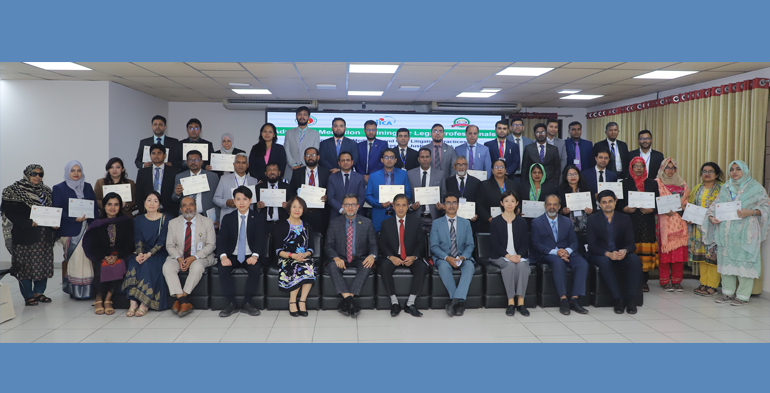
Agrilife24.com:As one of the key activities of the “Development of Mediation and Civil Litigation Practices for Enhancement of Access to Justice Project,” the Japan International Cooperation Agency (JICA), in collaboration with the Ministry of Law, Justice and Parliamentary Affairs (MoLJPA), conducted a two-day Advanced Mediation Training for legal professionals at the Judicial Administration Training Institute (JATI) on 21–22 December to strengthen the capacity of mediators. Building on prior foundational training held on 1–2 August, the program enhanced participants’ mediation knowledge and skills and explored practical ways to apply them in real-world cases.
The Project aims to lay the foundation for improved access to justice for all by enhancing the mediation system and strengthening the capacity of mediators. As part of efforts to improve the mediation framework, a system for conducting pre-case mediation by lawyers was introduced in legal aid offices in the project’s pilot districts of Narsingdi and Cumilla in April this year, leading to the successful resolution of a significant number of disputes through pre-case mediation. Furthermore, recent legal amendments inspired by this system introduced the role of Special Mediators in pre-case mediation, allowing well-trained and experienced lawyers, as well as retired judges, to serve as mediators. In this context, the mediation training implemented under the Project is essential to improving the quality of mediation in Bangladesh and making dispute resolution more accessible to all.
The training was delivered by a globally renowned Japanese mediation expert, Professor MIYATAKE Masako, and brought together 40 participants, including legal aid officers and lawyers from the pilot districts. The program covered a broad range of topics, beginning with a review of the fundamental concepts of mediation and progressing to more advanced knowledge and applied mediation skills through a combination of lectures and mock mediation exercises. A distinctive feature of the training was its highly interactive approach, which encouraged active engagement between the lecturer and participants, as well as practical mock mediations based on cases commonly encountered in Bangladesh, enabling participants to effectively apply the knowledge and skills acquired during the sessions.
All 40 participants successfully completed the training, and a certificate award ceremony was held in the presence of the Secretary of the Ministry of Law, Justice and Parliamentary Affairs (MoLJPA). During the ceremony, Professor MIYATAKE personally awarded certificates of completion to each participant.
In his remarks, Mr. Liaquet Ali Molla, Secretary, Law and Justice Division said “Mandatory mediation is not just a legal change- it's a commitment to accessable and efficient justice”
The training is expected to enable participants to effectively apply the knowledge and skills acquired through the program in their professional practice. By doing so, each participant is anticipated to play a key role in enhancing the mediation system as part of the Project’s efforts to improve access to justice and strengthen mediation practices in Bangladesh.