





















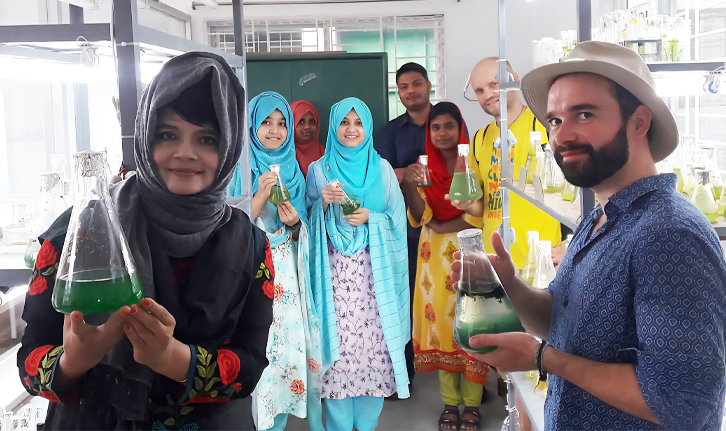
Mohammad Riaz, BAU:Researchers at Bangladesh Agricultural University (BAU) have developed an eco-friendly live fish feed technology using freshwater microalgae after three years of research, offering a sustainable and cost-effective alternative for freshwater aquaculture.
The researchers said the innovation is expected to reduce dependence on expensive fishmeal for feeding fish larvae, lower mortality rates, and improve fish growth and overall productivity.
The research was led by Professor Dr Saleha Khan of the Department of Fisheries Management at BAU.
Professor Dr Saleha Khan said one of the major challenges facing Bangladesh's freshwater aquaculture sector is the shortage of quality live feed and affordable aquatic feed for fish larvae and fry. The integrated technology has been developed for the first time in Bangladesh.
To address the problem, the research team developed a sustainable, nutritious and low-cost live feed, or aquafeed, using indigenous freshwater microalgae.
The feed is produced by collecting, isolating and processing a freshwater microalgae species known as Scenedesmus sp. through several stages to produce a nutrient-rich aquatic feed.
Professor Dr Saleha Khan said the primary objective of the research was to reduce fish production costs, develop an effective alternative to costly fishmeal, and establish a technology for the large-scale production of low-cost aquafeed. The research project was funded by the Bangladesh Academy of Sciences (BAS) and the United States Department of Agriculture (USDA).