





















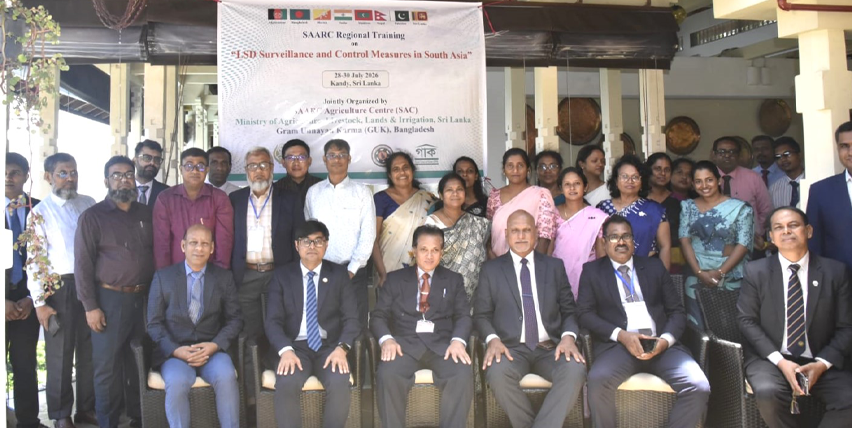
Md. Abul Bashar:A three-day SAARC Regional Training on “LSD Surveillance and Control Measures in South Asia” commenced Tuesday (28 July 2026) in Kandy, Sri Lanka, bringing together livestock experts and veterinary professionals from across the region aiming to strengthen cooperation in controlling Lumpy Skin Disease (LSD) through capacity development.
The inaugural session is jointly organized by the SAARC Agriculture Centre, Ministry of Agriculture and Livestock, Sri Lanka and Gram Unaayan Karma (GUK) Bangladesh where five SAARC Member States (Bangladesh, Bhutan, Nepal, Pakistan and Sri Lanka) participated in the program.
The inaugural session was welcome address by Dr. B.S.S. Perera, Director General, Department of Animal Production and Health (DAPH) and Chairman of the SAARC CVOs Forum. In his welcome address, he highlighted the importance of regional collaboration in addressing transboundary animal diseases.
Dr. Md. Younus Ali, Senior Program Specialist (Livestock), SAARC Agriculture Centre (SAC), outlined the objectives of the training and stressed the need for enhanced surveillance, early detection and coordinated response mechanisms across South Asia.
In his keynote presentation, Dr. S. Puvanendran, Virologist at the Veterinary Research Institute of Sri Lanka, said that Lumpy Skin Disease (LSD) is mainly spread by biting insects such as mosquitoes, flies and ticks. He highlighted that the virus can survive for long periods in skin lesions and scabs, while factors such as warm weather, animal movement and inadequate vector control contribute to its spread.
Special guest Md. Mukhlesur Rahman, Director of GUK, stressed the importance of raising farmer awareness and strengthening collaboration among farmers, veterinarians and development organizations for effective LSD prevention and control.
Special guest Dr. Md. Harunur Rashid, Director of the SAARC Agriculture Centre (SAC), highlighted the need for a coordinated regional approach to LSD surveillance and control. He stressed that South Asian countries should enhance information sharing, technical cooperation and capacity building to address transboundary animal diseases more effectively.
Special guest Dr. W.A.R.T. Wickramaarachchi, Director General of Agriculture, Sri Lanka and Governing Board Member of SAC, underscored the importance of integrating scientific research, surveillance systems and policy support to reduce the economic impact of LSD on livestock farmers.
Special guest Tanvir Ahmad Torophder, Director (ARD and SDF) of the SAARC Secretariat, stated that LSD poses a significant challenge to livestock development and rural livelihoods in SAARC Member states. He reaffirmed the SAARC Secretariat’s commitment to promoting regional cooperation, knowledge exchange and joint initiatives to strengthen disease prevention and control measures among member states.
Chief Guest Dr. A. Kalupahana, Dean of the University of Peradeniya, emphasized the importance of science-based approaches and research-driven strategies to strengthen LSD surveillance and control across the region. Guest of Honour Dr. S. Piyasiri, Additional Secretary of the Ministry of Agriculture, highlighted the need for stronger veterinary services, effective vaccination programs and enhanced regional cooperation to combat the spread of LSD in South Asia.
The training program started with strong appeal and urge for future collaboration of the sustainable livestock development in South Asia.