





















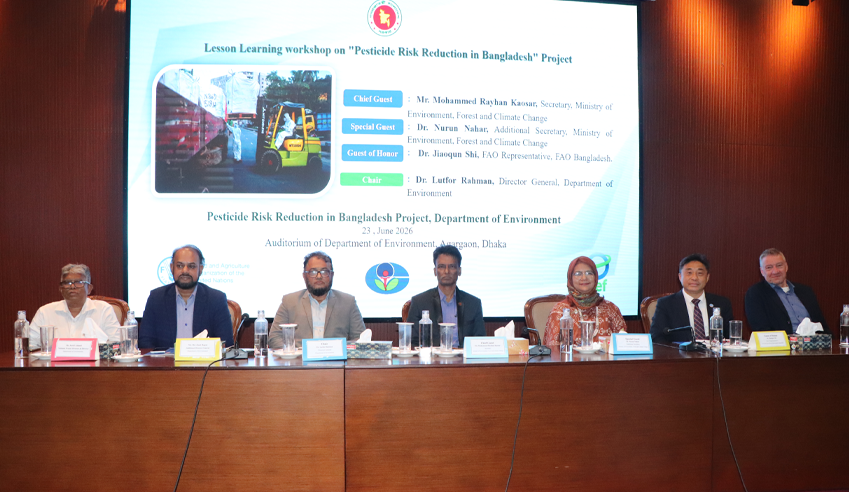
Agrilife24.com:The Department of Environment (DoE) under the Ministry of Environment, Forest and Climate Change (MoEFCC) in collaboration with the Food and Agriculture Organization of the United Nations (FAO), organized the Lesson Learning workshop on the Pesticide Risk Reduction in Bangladesh Project at the Department of Environment, Agargaon, Dhaka on 23 June 2026.
The event brought together representatives from the MoEFCC, the DoE, Department of Agricultural Extension (DAE), Department of Fisheries (DoF), Directorate General of Health Services (DGHS), research institutions, technical experts, private sector actors and development partners to reflect on the achievements, lessons learned and future pathways of the FAO–GEF Pesticide Risk Reduction Project in Bangladesh.
Funded by the Global Environment Facility (GEF), the project supported Bangladesh in strengthening pesticide lifecycle management, reducing risks from hazardous pesticides and persistent organic pollutants, and promoting safer, more sustainable practices across the agriculture and environment sectors.
Mohammed Rayhan Kaosar, honorable Secretary, MoEFCC, graced the event as the Chief Guest. In his remarks, he emphasized the importance of sustained national action to reduce pesticide risks, strengthen environmental governance, and protect public health and ecosystems. He stated, “Reducing dependence on Highly Hazardous Pesticides is essential to protect human health, food safety, and the environment. Promoting integrated pest management, bio-pesticides, and good agricultural practices can ensure safer and more sustainable agriculture. Strong collaboration among stakeholders is key to advancing sustainable pest management in Bangladesh.”
Jiaoqun Shi, FAO Representative in Bangladesh, and Guest of Honour, stated, “The successful removal and environmentally sound disposal of 525 metric tons of obsolete DDT represents a landmark achievement in Bangladesh’s efforts to eliminate harmful persistent organic pollutants and protect both human health and the environment. It required efforts from more than 17 ministries along with many other national and international partners; and FAO takes pride in being part of this historic initiative. The lessons documented through this project should now inform future policy reforms, institutional strengthening and investment in safer agrifood systems”. He reaffirmed FAO’s commitment to supporting the Government of Bangladesh in advancing safer and more sustainable agricultural systems.
The project also contributed to strengthening pesticide related regulatory processes, laboratory capacity, field-level awareness, safer pesticide use, empty pesticide container management, poison surveillance, and the promotion of bio-rational alternatives.
The workshop opened with remarks by Farid Ahmed, National Project Director, Pesticide Risk Reduction in Bangladesh project and Director, DOE. Martijn Van De Groep, Team lead and Senior Technical and Policy Advisor, FAO, presented the key achievements of the project, highlighting the progress made in strengthening national capacity, improving pesticide management systems and supporting safer practices.
Participants also joined an interactive discussion on lessons learned and possible follow-up actions. The discussions emphasized the need to sustain and institutionalize the project’s gains, strengthen inter-agency coordination, expand capacity building, improve waste management systems, and promote integrated approaches to pesticide risk reduction, food safety, public health and environmental protection.
The workshop featured a presentation on a potential initiative titled Circular Solutions for Agriculture Plastics Pollution in Bangladesh (CSAPP) aiming to build on the lessons of the Pesticide Risk Reduction in Bangladesh project by exploring circular solutions to address agricultural plastic pollution and support more sustainable agrifood systems in the country.
The session concluded with closing remarks by Md. Lutfor Rahman, Director General, DoE. He appreciated the contributions of all partners and emphasized the importance of carrying forward the project’s achievements through continued collaboration and follow-up action.
The Pesticide Risk Reduction project in Bangladesh has helped establish a stronger foundation for sound pesticide lifecycle management. The lessons generated through the project are expected to guide future initiatives on pesticide risk reduction, sustainable waste management, circular economy solutions and environmental protection.
FAO remains committed to working hand in hand with the Government of Bangladesh and all partners to promote safer agriculture, healthier communities and a cleaner environment, ensuring better production, better nutrition, a better environment and a better life, leaving no one behind.