





















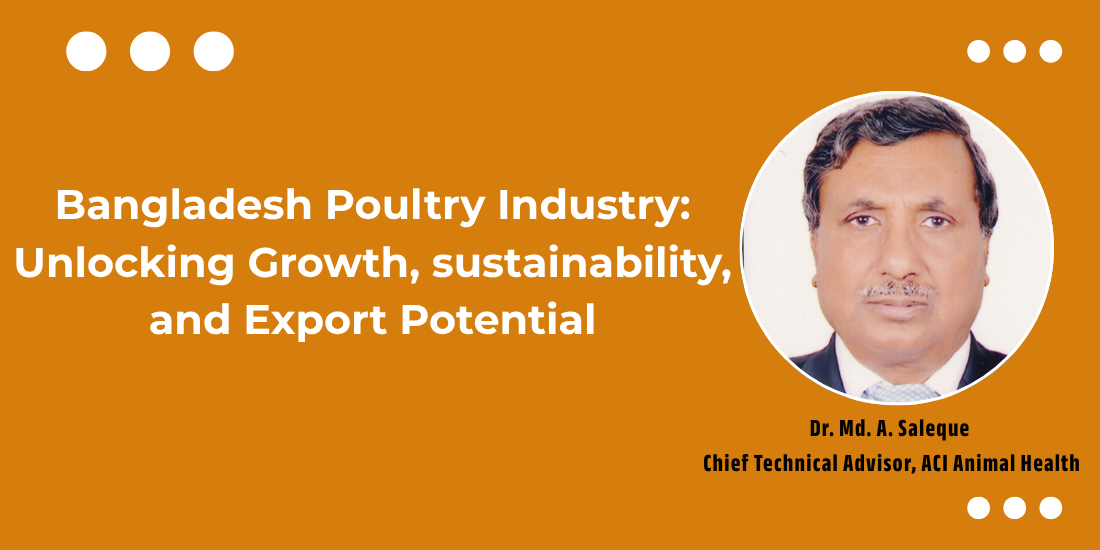
Written by Dr. Md. A. Saleque, Chief Technical Advisor, ACI Animal Health:The poultry sector is one of the most dynamic segments of Bangladesh's agricultural economy, contributing significantly to food security, nutrition, employment, and economic growth.
Over the last two decades, the industry has evolved from small-scale farming into a modern, commercially integrated value chain encompassing breeding, hatcheries, feed mills, poultry production, processing, and marketing.
Today, the sector supports approximately 8.5 million jobs, including 2.5 million direct and 6.0 million indirect employment opportunities, while providing livelihoods to more than one million farmers and entrepreneurs. With an estimated investment of USD 3.2 billion (BDT 40,000 crore) (WPSA-BB/BPICC, 2026), poultry has become one of the country's largest and most influential agribusiness sectors.
Driven by rising consumer demand for affordable and high-quality animal protein, poultry production has expanded significantly. In 2025, Bangladesh produced approximately 24.4 billion eggs (DLS, 2025) and 1.84 million metric tons of poultry meat (ACI Report ,2026 & Author's calculation), resulting in annual per capita consumption of 137 eggs (DLS, 2025) and 10.7 kg of poultry meat (WPSA-BB/BPICC, 2026). This represents remarkable progress compared with 2011, when annual per capita consumption stood at only 48 eggs and 3.9 kg of poultry meat (Nourish, 2025).
The industry's growth has been supported by a well-developed input supply system. The breeding and hatchery segment has expanded rapidly, with five Grand Parent (GP) farms producing approximately 10.5 million Parent Stock (PS) or breeder day-old chicks (DOCs) annually (ACI report,2026 and Author’s calculation). More than 100 Parent Stock farms collectively produced about 1.05 billion broiler DOCs, 62-million-layer DOCs, and 244 million Sonali and colored-bird DOCs in 2025 (ACI report,2026 and Author’s calculation). Current weekly production stands at approximately 20.2 million broiler DOCs, 1.2-million-layer DOCs, and 4.6 million Sonali and colored-bird DOCs (BAB, 2026).
Bangladesh now has an estimated 100,000 commercial poultry farms, including around 60,000 broiler farms, 23,000-layer farms, and 13,000 Sonali and colored-bird farms (DLS, 2026; BPICC, 2026). Contract farming and integrated production systems are expanding steadily and currently account for approximately 17% of broiler production and 19% of layer production (ACI report,2026 and Author’s calculation). Small-scale farmers continue to play a crucial role, contributing nearly 35% of commercial poultry production and supporting rural livelihoods throughout the country (Saleque et al., 2023).
The feed industry has also experienced significant growth alongside the expansion of the poultry sector. Bangladesh currently has more than 350 feed mills in operation. Annual poultry feed production has reached approximately 6.2 million metric tons (MT), accounting for nearly 70% of the country's total commercial feed production of 9.1 million MT (FIAB, 2026; Authors’ calculation). Commercial feed manufacturers supply about 75% of the feed used by layer farms, while the remaining 25% is produced by farmers themselves. Feed remains the single largest production cost component, representing approximately 60–70% of total poultry production expenses (Authors’ calculation).
Despite its impressive growth, value addition within the poultry value chain remains limited. Approximately 94% of poultry products are marketed through traditional wet markets, while only 6% are processed through the country's 12 modern slaughtering and processing facilities. Furthermore, nearly 99% of poultry products are consumed domestically (ACI report,2026 and Author’s calculation), underscoring the substantial potential for expansion in processing, branding, value-added products, and export-oriented production.
The industry continues to face several structural challenges. These include heavy dependence on imported feed ingredients and breeding stock, rising feed costs, disease outbreaks, inadequate cold-chain infrastructure, market price volatility, Waste management problems, climate-related risks, and limited export readiness. Such constraints affect production efficiency, farmer profitability, and the overall competitiveness of the sector.
At the same time, significant opportunities exist for future growth. Rising incomes, population growth, urbanization, increasing adoption of integrated farming systems, modernization of processing facilities, and growing consumer preference for safe, hygienic, and branded poultry products are expected to drive further expansion. In addition, Bangladesh has strong potential to access the rapidly growing global halal food market, creating new opportunities for export diversification and foreign exchange earnings. Realizing this potential will require strengthened biosecurity and disease surveillance systems, supportive government policies, investments in processing and cold-chain infrastructure, development of internationally recognized disease-free zones, enhancement of food safety and traceability systems, and stronger collaboration between public and private stakeholders. Improving productivity, reducing production costs, and achieving compliance with international quality standards will be essential for enhancing global competitiveness.
Under the Poultry Vision 2030 outlook, the sector aims to increase total investment to approximately USD 4.2 billion (ACI report,2026 and Author’s calculation), raise annual per capita consumption to 165 eggs and 15 kg of poultry meat, and generate employment opportunities for more than 10 million people (BPICC, 2026). Achieving these targets will further strengthen the sector's contribution to national food security, nutrition, and economic development. With continued policy support, technological innovation, private-sector investment, and coordinated efforts among industry stakeholders, Bangladesh is well positioned to build a sustainable, resilient, and globally competitive poultry industry.