


















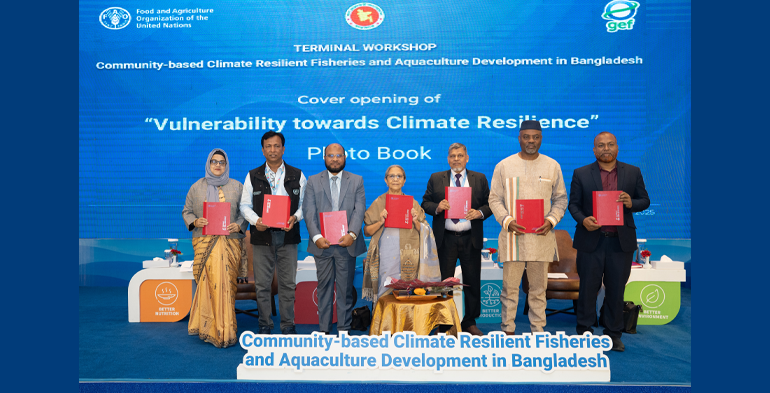
Agrilife24.com:The Community-based Climate Resilient Fisheries and Aquaculture Development in Bangladesh project, supported by the Global Environment Facility (GEF) and implemented by the Food and Agriculture Organization of the United Nations (FAO) in partnership with the Department of Fisheries, has officially concluded, marking five years of substantial progress in strengthening climate-resilient fisheries and aquaculture systems across the country. A terminal workshop event was held today at Hotel Intercontinental and graced by Farida Akhter, honorable Adviser, Ministry of Fisheries and Livestock as the Chief Guest.
Over its implementation period, the project undertook comprehensive climate risk assessments, piloted climate-smart aquaculture technologies, and introduced community-based resource management practices in nine climate-vulnerable coastal upazilas. It further enhanced early-warning mechanisms and improved the capacity of fishing and aquaculture-dependent households to better withstand climate shocks.
The project directly supported 127 Community-Based Organizations (CBOs), trained thousands of households, and introduced livelihood diversification initiatives, sustainable aquaculture technologies, and resilience-building interventions. These efforts contributed to increased household income, improved fish production, and strengthened community preparedness for climate-related disasters.
“The results we see today are a testament to what can be achieved through collaboration, innovation, and community spirit. The project has empowered communities, touching the lives of thousands of households. I am particularly encouraged by the data showing an average 33% increase in monthly household income among participants and that 72.6% reported higher fish production. This translates to greater food security, economic stability, and resilience against climatic shocks.” – said Farida Akhter, honorable Adviser, Ministry of Fisheries and Livestock.
Valantine Achancho, FAO Representative in Bangladesh (a.i.), emphasized the value of local adaptation efforts, stating,
“At the community level, the project has made a meaningful difference in the lives of fishers, aquaculture farmers, and of people whose livelihoods depend on natural water bodies. Thousands of households were trained on climate variability, disaster risk reduction, and climate-resilient adaptation strategies, allowing communities to anticipate and respond to climate threats more effectively.”
Dr. Md. Abdur Rouf, Director General of the Department of Fisheries, highlighted the long-term significance of the initiative; he said,
“Over the past five years, this project has played a transformative role in strengthening the resilience of vulnerable fishing communities across Bangladesh. Through improved aquaculture practices, enhanced early-warning capacities, climate-smart technologies, and community-based management, the project has significantly contributed to protecting livelihoods and ensuring sustainable food systems in the face of climate change.”
The closing event is a testament to FAO’s commitment in scaling up climate-resilient technologies, strengthening community-based fisheries and aquaculture systems, and expanding successful models in Bangladesh for better production, better nutrition, a better environment and a better life, leaving no one behind.