





















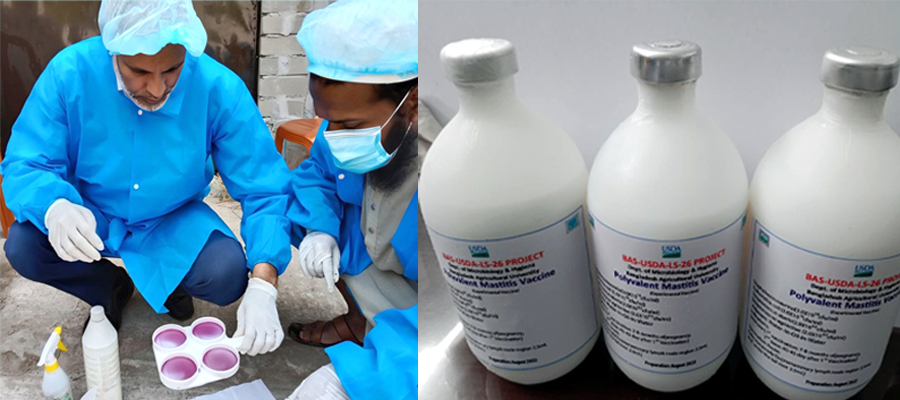
Mohammad Riaz, BAU:Inflammation of the udder, commonly known as mastitis, is one of the most familiar and financially damaging diseases affecting dairy cows in Bangladesh. This disease drastically reduces milk production and damages the quality of the milk. In severe cases of acute inflammation, the cow’s udder can even be permanently damaged.
While mastitis is generally caused by various types of common microbes, a team of researchers at Bangladesh Agricultural University (BAU) has recently identified a new pathogen responsible for this disease in dairy cows. Alarmingly, this pathogen is zoonotic meaning it can spread from animals to humans. Close contact with infected cows can cause pneumonia, urinary tract infections, and septicemia (blood poisoning) in individuals with weakened immune systems.
The new pathogen was identified by Professor Dr. Md. Bahanur Rahman from the Department of Microbiology and Hygiene at BAU. Dr. Md. Habibur Rahman served as the co-researcher in this study, which spanned three and a half years, beginning in December 2022.
The identified bacteria has been named Enterobacter cloacae. It is a rod-shaped, Gram-negative bacterium that exhibits strong resistance to multiple types of antibiotics.
"This bacteria is typically found on barn floors and in dirty environment," explained Professor Dr. Md. Bahanur Rahman. "The risk of infection spikes when a cow's udder comes into direct contact with these contaminated floors. However, this disease can easily be prevented by properly cleaning the udder after milking and regularly disinfecting the barn floors. Additionally, to avoid the risk of antimicrobial resistance (AMR) in cows, the unregulated use of antibiotics must be stopped immediately."
Dr. Bahanur Rahman added , "To prevent mastitis, we have developed a vaccine named 'BAU Polyvalent', which is roughly 80% effective against this disease. Although production costs are currently high, mass production under government supervision could make it highly affordable for local farmers. The vaccine requires a primary dose six months before calving, followed by a second booster dose within one and a half months after delivery. This regimen boosts the cow's immunity and nearly eliminates the risk of contracting mastitis."
He further added, "a contract is about to be signed between the Bangladesh Academy of Sciences (BAS), the Incepta Vaccine Division, and Bangladesh Agricultural University (BAU). With their financial support, it will be possible to verify the vaccine’s effectiveness more extensively and deliver a higher-quality vaccine to the farmers."