


















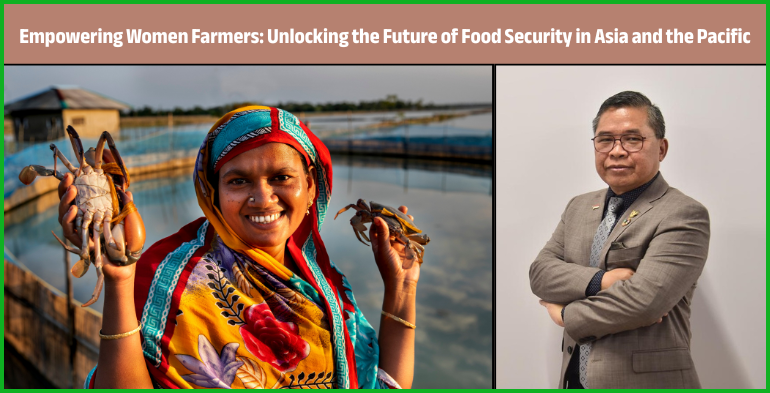
By Alue Dohong, Assistant Director-General and Regional Representative, Food and Agriculture Organization of the United Nations (FAO)
Walk through any rice paddy in Southeast Asia, any market in the Pacific islands, any fishing village along the Bay of Bengal — and you will find women working. Planting, harvesting, processing, and selling. Nearly 58 percent of employed women across Asia and the Pacific work in agriculture. They are the backbone of how this region feeds itself.
And yet, for all their labor, women farmers continue to face persistent and systemic barriers.
Only 10 to 20 percent of women in the region hold land tenure rights. Without a title to the land they work on, women cannot access credit, cannot make long-term investments, and cannot fully benefit from the systems they spend their lives sustaining. When they do earn wages, they take home 82 cents for every dollar their male counterparts earn.
From 20 to 24 April, Ministers of agriculture, senior officials, and delegates from 46 countries will gather in Brunei Darussalam for the 38th Session of the FAO Regional Conference for Asia and the Pacific (APRC 38) to set the region's priorities for food and agriculture. This year, with the United Nations having declared 2026 the International Year of the Woman Farmer, we must recognize the pivotal roles women play and prioritize achieving gender equality across agrifood systems.
Addressing these inequalities is not just a matter of fairness, it is fundamental to the issues we care about — food insecurity, climate resilience, rural poverty, and sustainable development. We cannot meaningfully progress on any of these challenges while leaving women behind.
Research from FAO suggests that closing gender gaps in farm productivity and wages in agrifood systems could add a trillion dollars to global GDP and lift 45 million people out of food insecurity. Action would also improve household well-being, strengthen resilience to climate change, and accelerate progress toward the Sustainable Development Goals. Empowered women farmers are key agents of change.
What would genuine commitment look like? It means addressing discrimination, institutional biases, and policy gaps that continue to limit women’s full and equal participation in agrifood systems. It would look like financial institutions designing women-friendly products for smallholder women farmers and providing technical training and market information so women can boost their productivity.
FAO is promoting gender-transformative actions that address the root causes of inequality by shifting norms, power relations, and institutional practices. These approaches require the engagement of all stakeholders.
Across the region progress is already happening. Governments are moving from commitment to action. Cambodia, Nepal, Pakistan, Papua New Guinea, and Sri Lanka are implementing programs that challenge discriminatory norms and structural barriers, while bringing not just women but also men in as partners for change. Women-led cooperatives and producer groups are reshaping value chains and demonstrating what inclusive leadership looks like in practice. In 2023, the Committee on World Food Security adopted Voluntary Guidelines to help governments build gender-responsive policies and investments that foster women’s full, equal, and meaningful participation, voice, and leadership in agriculture.
These efforts are not isolated experiments. They show what can be achieved. We must connect them, learn from them, and build on them.
APRC38 arrives at the right moment to do that. The conference brings together ministers of agriculture, senior officials, and representatives from civil society and the private sector with a focus on improving food security, advancing climate-resilient agriculture, and promoting inclusive policies that benefit smallholders, women, youth, and vulnerable populations.
2026 offers a unique opportunity to turn visibility into lasting change. The International Year of the Woman Farmer brings renewed attention and calls for collective action and increased investment by governments, partners, and the private sector to close gender gaps, strengthen women’s livelihoods, and promote their leadership across agrifood value chains.
Sustaining and accelerating progress requires continued collective effort. FAO remains firmly committed to working with Member Nations and partners to translate commitments into action.