


















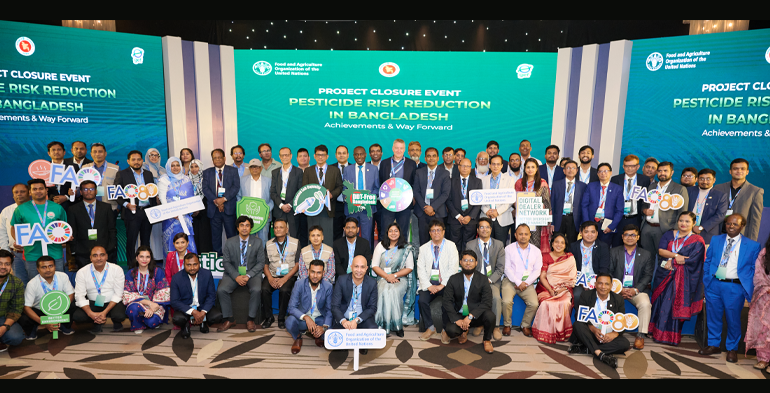
Agrilife24,com:The Food and Agriculture Organization of the United Nations (FAO) marked the closing of the Pesticide Risk Reduction in Bangladesh project today at Hotel Intercontinental, Dhaka. Launched in August 2021, this flagship initiative implemented with the Government of Bangladesh and funded by the Global Environment Facility (GEF). The implementation is led by the Department of Environment (DoE) with support from the Department of Agricultural Extension (DAE), Department of Fisheries (DoF) and Directorate General of Health Services (DGHS).
The event gathered senior government officials, development partners, technical experts, private sector representatives and academics to review achievements in pesticide lifecycle management and discuss pathways for sustaining progress.
“This project reflects Bangladesh’s commitment to stronger environmental governance and safer food systems,” said Farhina Ahmed, Secretary, Ministry of Environment, Forest and Climate Change, who attended the event as Chief Guest. “Enhancing regulation, institutional capacity and public awareness have laid the groundwork for a healthier, more resilient country. Sustained collaboration and strong enforcement will be key in the years ahead.”, she added
Special Guests S.M. Sohrab Uddin, Director General, DAE; Dr Md Abdur Rouf, Director General, DoF; and Prof M. Abul Faiz, President, Toxicology Society of Bangladesh, highlighted the project’s contributions to safe pesticide use, aquaculture integrity and strengthened poison surveillance respectively.
Farid Ahmed, National Project Director, DoE, presented the project’s objectives and multi-agency collaboration. This was followed by a technical presentation from Martijn van de Groep, Senior Technical Advisor, FAO Bangladesh, who outlined key achievements and strategies for sustaining the project outcomes. “Through FAO’s Pesticide Lifecycle Management framework, this project assisted governments to ensure that every stage of pesticide handling—registration, trade, use, and waste management—is conducted safely and sustainably, aligning with international standards and best practices. Our focus has been on building resilient systems that will protect farmers, consumers and ecosystems long after project completion,” he said.
As Guest of Honor, Dia Sanou, Deputy FAO Representative in Bangladesh, reaffirmed FAO’s commitment to supporting national efforts. “By strengthening regulatory systems, upgrading laboratories and promoting safer practices, we are contributing to better production, better nutrition, a better environment and a better life, leaving no one behind”.
The event concluded with remarks from Md Kamruzzaman, ndc, Director General, Department of Environment, who commented on the project’s achievements and stressed the importance of continued inter-agency coordination.
About the project
The Pesticide Risk Reduction in Bangladesh project applied a comprehensive pesticide lifecycle management approach, strengthening regulatory frameworks, institutional capacity, laboratory systems and field-level practices.
Key achievements include:
- Elimination of 525 metric tons of obsolete DDT, enabling Bangladesh to be recognized as a DDT-free country.
- Preparations for ratification of the Rotterdam Convention.
- Revision and updating of pesticide rules and regulations to strengthen sustainability and alignment with international standards.
- Establishment of a national pesticide dealer network, automation of dealer registration, and strengthened market control mechanisms.
- Upgrading institutional and laboratory capacities, including poison surveillance, pesticide residue monitoring and pesticide-free fish processing.
- Promotion of bio-rational and low-hazard pest management practices with extensive training, field demonstrations and outreach to farmers and field-level officers.
- Systematic collection and safe disposal of primary pesticide packaging waste (PPPW) through coordinated engagement of farmers, dealers and manufacturers.
The project was funded by the Global Environment Facility (GEF) and executed by FAO in close partnership with the Government of Bangladesh.